
The automotive technical review (RTA) remains the reference document for anyone wanting to work on their vehicle without systematically going through a garage. Torque specifications, timing belt alignment procedures, electrical diagrams: this data cannot be improvised. Finding a free automotive technical review in PDF format is a common search, but the results often lead to dead ends, incomplete files, or dubious platforms.
European regulation and access to technical documentation: what the law requires from manufacturers
Regulation (EU) 2018/858 requires manufacturers to provide independent repairers with non-discriminatory access to technical information: diagrams, repair procedures, OBD data. The communications from the European Commission in 2022 and 2023 have reinforced this obligation.
This regulatory constraint has had a direct effect. Official portals originally intended for professionals have opened, at least partially, to the general public. Stellantis’ Service Box (Peugeot, Citroën, Opel, DS) and the Renault Service Repair portal now offer excerpts available for read-only access or temporary access to their workshop documentation.
Before attempting to download a free automotive technical review in PDF from a third-party site, checking these manufacturer portals remains the most reliable approach. The documentation there is up-to-date, compliant with the exact model of the vehicle, and its distribution is legal.

Manufacturer portals and training databases: often overlooked legal sources
The proliferation of official portals has led to a secondary phenomenon. PDFs from this documentation circulate on university and professional training sites in mechanics, accessible for free after registration. These documents are not pirated: they fall under authorized dissemination within an educational framework.
The Stellantis group and Renault are pioneers in this openness. In contrast, other manufacturers (notably some German brands like BMW) remain more restrictive. Full access to their workshop manuals generally requires a paid subscription on their dedicated portals.
Media libraries and digital libraries
In recent years, several French libraries and media libraries have negotiated subscriptions to databases of automotive technical documentation. A subscriber can consult, and sometimes download, technical reviews for a wide range of models.
This channel remains underutilized. Most motorists do not think of their local media library when looking for a timing diagram for a Renault or Citroën engine. Access is often remote, via a library ID, allowing users to consult the documentation from home.
Free PDF files on sharing platforms: concrete limitations
Platforms like Scribd host documents titled “Free Automotive Technical Review PDF.” Mechanical help forums, such as Techniconnexion, are also full of sharing links. The reality of these files deserves careful examination.
- The compatibility with the exact model of the vehicle is never guaranteed. An RTA intended for a 1.6 HDi engine does not cover the specifics of a 2.0 HDi, even on the same chassis.
- Files shared on forums may be several years old. Updates related to manufacturer recalls or changes in engine specifications are not included.
- The quality of scans varies significantly: some PDFs are unreadable on electrical diagrams, precisely where accuracy matters most.
- Legally, sharing an RTA protected by copyright remains an infringement, even between individuals and even for free.
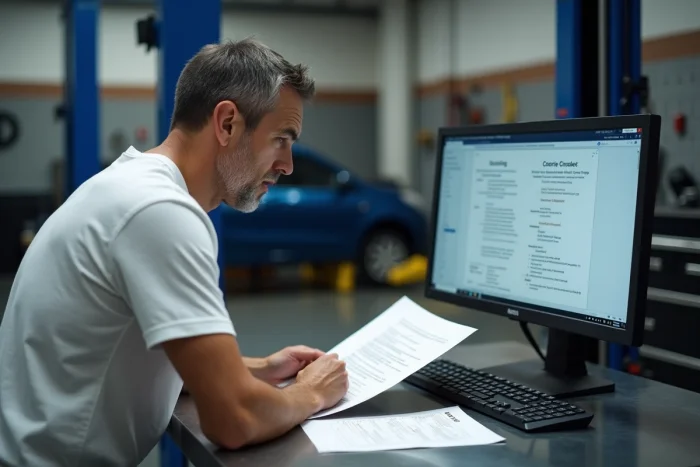
Free RTA in PDF: how to verify the reliability of a file before using it
A technical PDF file applied to a vehicle involves safety. Using an incorrect torque specification on a cylinder head or an incomplete wiring diagram on an engine control unit can cause mechanical failure or a short circuit.
Three checks can help limit risks before using a document found online:
- Cross-check the document’s reference number with the exact engine code of the vehicle. The engine code is found on the registration certificate (field D.2) and on a plate riveted to the engine block.
- Compare at least one technical data point from the PDF (cylinder head torque, coolant capacity) with the official technical sheet from the manufacturer, available on their portal.
- Check the document’s publication date. An RTA prior to a major technical recall may contain outdated procedures.
A document that is undated and lacks an identifiable publisher should not serve as a basis for work on the engine, braking, or steering.
The case of older models
For vehicles over twenty years old (Rover, older Citroëns, Renaults from the 1990s), the situation is paradoxically more favorable. The RTAs for these models are no longer subject to active commercial exploitation. Their dissemination in PDF format on specialized forums is effectively tolerated, and the documentation is often complete as these vehicles have not received technical updates.
Alternatives to classic RTAs for routine maintenance
Technical reviews cover all possible interventions on a vehicle, from oil changes to cylinder head gasket replacements. For routine maintenance (filters, brakes, timing), the maintenance manuals published online by manufacturers are often sufficient.
These free documents specify replacement intervals, part references, and fluid quantities. They do not replace a complete RTA for heavy repairs but cover the majority of operations that an individual can perform in their garage.
The line between legal free documentation and pirated files remains blurred on many platforms. Manufacturer portals, digital libraries, and professional training sites are the only sources where technical reliability and legality are not in question. For the rest, each downloaded file requires manual verification that many users, eager to disassemble their engine, overlook.