
Choosing a chainsaw to maintain your garden involves comparing parameters that are not always listed on the packaging. Cutting length, type of motorization, real-world weight, noise level: these data points vary significantly from one model to another and affect both user comfort and the quality of the result.
The goal is not to find the most powerful machine, but one whose technical characteristics match the exact profile of your land and your plant species.
Noise level and local regulations: an underestimated criterion in choosing a chainsaw
Most comparative guides rank chainsaws by power or type of motorization. They overlook a factor that increasingly influences the actual choices of individuals: the noise emitted and the municipal regulations that govern it.
In many French municipalities, municipal regulations limit the hours of use for motorized equipment in gardens. The main reason cited by communities that abandon thermal models for maintaining their residential green spaces is the reduction of noise disturbances for neighbors, more than the ecological argument. This logic of neighborhood acceptability also applies to individuals in housing estates or townhouses.
The catalogs available on elagueuse-warrior.com allow filtering models by their motorization, making it easier to compare thermal and battery options based on this specific criterion.
Several town halls now explicitly recommend electric or battery-powered devices. If you live in a dense area, checking your municipality’s regulations before purchasing avoids an unpleasant surprise: a high-performance thermal model can become unusable half the week due to time restrictions.
Thermal, battery, or corded chainsaw: a comparative table of motorizations
The choice of motorization determines autonomy, weight, noise, and maintenance budget. Here is a summary of the differences between the three main categories.

| Criterion | Thermal | Battery | Corded |
|---|---|---|---|
| Cutting power | High (large branches) | Medium to good | Medium |
| Autonomy | Limited by the tank (several hours) | Limited by the battery (variable depending on voltage) | Unlimited (mains) |
| Weight | Heavier | Intermediate | Lighter |
| Noise level | High | Moderate | Moderate |
| Engine maintenance | Regular (spark plug, filter, fuel) | Low | Low |
| Range | Total | Total | Limited by the cable |
The thermal model remains the most suitable for pruning large diameter branches in isolated situations. On the other hand, batteries dominate for medium-sized residential gardens, where noise and maneuverability are as important as raw power.
A point rarely addressed in comparisons: modular battery systems. Several manufacturers offer platforms where the same battery powers chainsaws, hedge trimmers, and blowers. This battery sharing reduces the overall cost of equipment and the bulk in a garage or garden shed.
Classic chainsaw or pole saw: cutting capacity and safety
The distinction between a pruning chainsaw and a pole saw is not just about the length of the handle. It involves two working postures, two levels of risk, and two ranges of cutting diameter.
Pruning chainsaw: maneuverability up close
The pruning chainsaw is a compact machine with a short guide bar, designed for working at height (on a ladder or in a tree). Its light weight makes it maneuverable, but it requires positioning close to the branch to be cut. It is suitable for shrubs and branches of small to medium diameter.
Pole saw: pruning from the ground
The pole saw (fixed or telescopic) allows cutting branches at height without leaving the ground. The motor is usually located at the base, improving balance. Models with an adjustable head allow a cutting angle of 0 to 90°, providing access to branches that would otherwise be unreachable.
- Fixed pole: stiffer, better cutting precision on targeted branches, but non-adjustable length.
- Telescopic pole: adjustable in height, versatile, but slightly heavier and prone to vibrations at maximum extension.
- Adjustable head: access to lateral and upper branches without repositioning on the ground, significantly saving time on a bushy tree.
From a safety perspective, the pole saw reduces the risk of falling since the operator remains on the ground. For a garden with medium-height trees, this type of machine limits dangerous situations related to working at height.
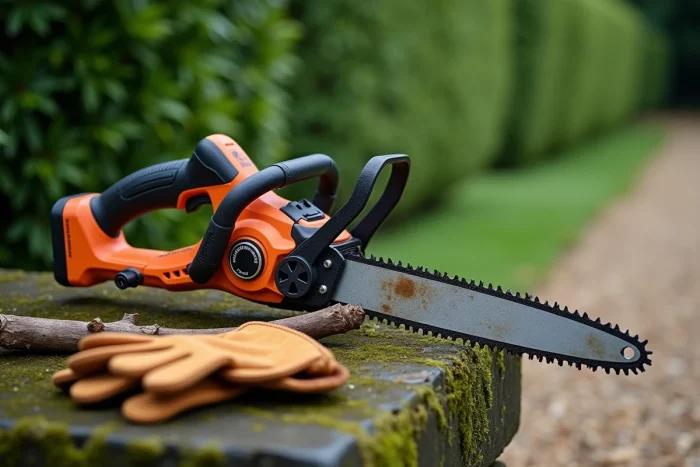
Battery voltage, guide length, and chain: specifications to check before purchase
Three technical parameters separate a suitable chainsaw from a disappointing purchase.
The battery voltage (expressed in volts) determines the available power. The higher the voltage, the more the machine can tackle hard woods or large diameters without stalling. Entry-level models operate at low voltage and are suitable for softwood. For species like oak or ash, a higher voltage becomes necessary.
The length of the guide bar determines the maximum cutting diameter in a single pass. A short guide (around twenty centimeters) is sufficient for thin branches and routine maintenance work. A longer guide allows tackling wider sections but adds weight to the machine and complicates handling at height.
- Low kickback chain: reduces the risk of kickback, recommended for non-professional users.
- Narrow chain pitch: finer cut, less effort, suitable for precision pruning.
- Tool-less chain tensioner: allows quick adjustment on-site, avoiding prolonged interruptions.
Before purchasing, also check the availability of wear parts (replacement chain, guide). A model whose consumables are hard to find becomes expensive to maintain in the long term, even if the initial purchase price seems attractive.
Insurance implications also deserve attention. Some home insurance policies require that cutting tools used in the garden comply with current standards. Checking the conditions of your contract before significant pruning helps avoid a denial of coverage in case of an incident.
The final choice depends on the intersection of these data with the reality of your land: present species, tree height, pruning frequency, and neighborhood constraints. A well-sized chainsaw is recognized by a simple detail: it makes the work smooth instead of complicating it.