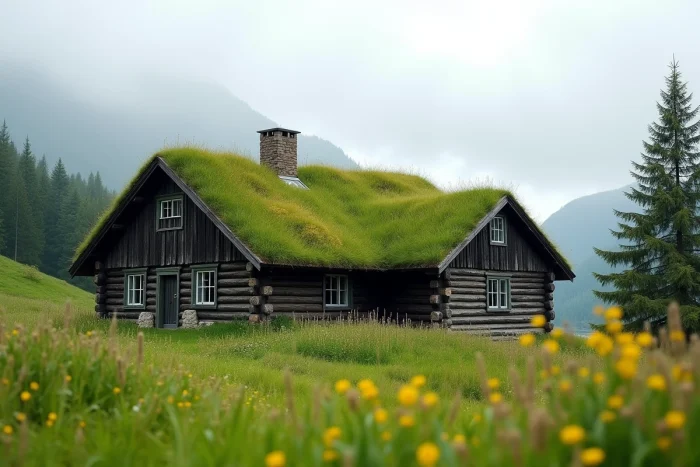
In Norway, tufts of grass grow on the roofs of houses. This is not a decorator’s whim. It is a construction technique that dates back to the Viking era and still equips both mountain chalets and recent urban buildings today.
Norwegian grass roofs rest on a simple principle: a wooden frame, a layer of birch bark for waterproofing, followed by soil and vegetation on top. This natural sandwich protects against the cold, absorbs rain, and blends into the landscape. Understanding how it works helps to grasp why architects and communities are once again interested in it.
Birch Bark and Substrate: The Hidden Structure of a Norwegian Green Roof
Have you ever noticed that grass roofs seem to hold up effortlessly? The key lies beneath the layer of soil, in an element that photos never show: birch bark serves as a waterproof membrane.
Traditionally, builders stacked several layers of bark on the roof boards. Birch bark contains betulin, a substance that makes it naturally waterproof. This layer blocks rainwater and melted snow before they reach the frame.
On top comes a thick substrate of soil mixed with peat. This mass is heavy, which explains why traditional Norwegian frames are oversized compared to those of a classic house. The weight also stabilizes the roof against the wind.
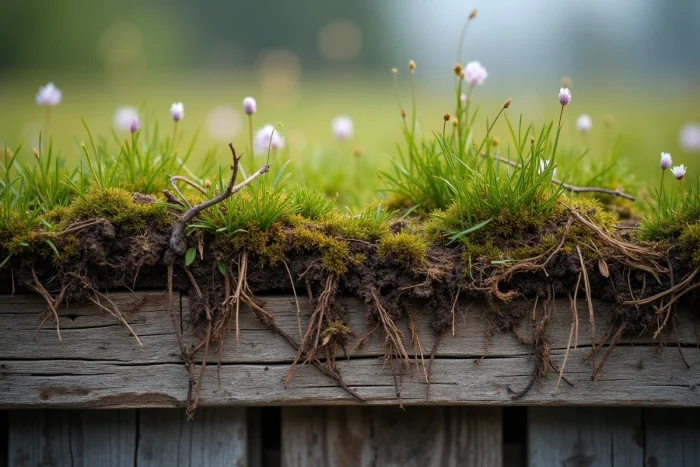
Finally, the vegetation settles on its own or is sown. It includes grasses, mosses, and sometimes wildflowers. The roots create a dense network that holds the soil in place, even on steep slopes. A detailed article on grass roofs in Norway discusses how this layering of materials has endured through the centuries.
What distinguishes this technique from modern green roofs with thin substrates is precisely the thickness of the substrate. A technical report from the Institute for Energy Technology (IFE) published in 2021 shows that traditional grass roofs provide more stable seasonal insulation than some contemporary lightweight green roofs, particularly in buffering temperature variations between day and night.
Thermal Insulation and Water Management: The Real Performance of Grass Roofs
Why choose a heavy and constraining roof instead of a simple tiled roof? Because the earthen substrate acts as a passive thermal regulator.
In winter, the layer of soil and vegetation traps a mass of air between its fibers. This still air slows down heat loss. In summer, the phenomenon reverses: the moist soil and the evapotranspiration of plants cool the roof surface. The temperature under the roof remains more constant than with a mineral or metal covering.
The other concrete advantage concerns rain. Norway receives abundant precipitation, especially on the west coast. A grass roof retains a significant portion of rainwater in its substrate before gradually releasing it. This delay reduces pressure on drainage systems, a point that directly interests cities facing intense rainfall events.
The Nordic Council of Ministers, in a 2023 report, notes that several Norwegian municipalities (Oslo, Bergen, Trondheim) are now integrating green roofs into their climate change adaptation strategies. The goal goes beyond heritage conservation: these roofs serve as a tool against urban heat islands and rain flooding.
BREEAM-NOR Credits and Local Biodiversity: A Heritage Turned Regulatory Leverage
The tradition has taken on a recent regulatory dimension. Since the update of the BREEAM-NOR standard in 2022, the Norwegian Green Building Council (NGBC) grants specific credits for green roofs. Two areas are concerned:
- Local biodiversity: a grass roof hosts pollinating insects, microorganisms, and endemic plant species. In dense urban areas, it restores a fragment of natural habitat where concrete has removed it.
- Rainwater retention: the substrate and roots absorb and filter water, limiting direct runoff to the drainage systems.
- Enhancement of vernacular in new builds: project owners who integrate traditional techniques (including grass in rural areas) receive formal recognition in building certification.
This framework has reignited interest among developers. Building a green roof costs more to install than a conventional covering. But BREEAM-NOR credits facilitate the financing and marketing of certified projects.
The Socio-Cultural Role of Grass Roofs in Norwegian Rural Valleys
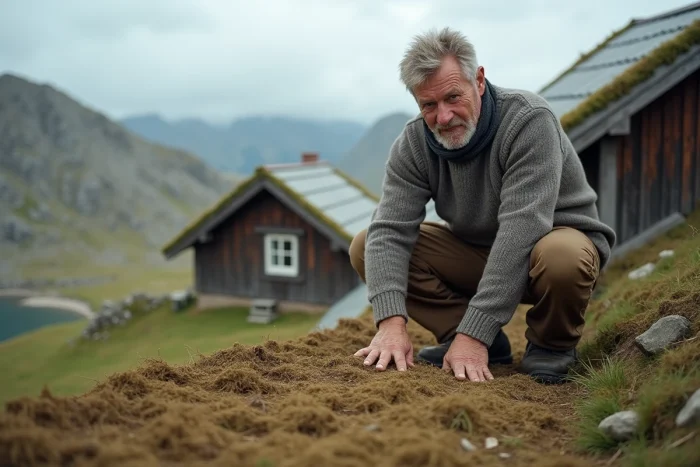
A field study conducted by the Norwegian University of Life Sciences (NMBU) in 2020, in rural valleys of southern Norway, documents an aspect that technical analyses overlook. Grass roofs still play a concrete socio-cultural role there.
In these communities, maintaining a grass roof involves a know-how passed down through generations. The choice of plants, the repair of the bark layer, the observation of drainage throughout the seasons: these actions connect residents to their built environment in a way that industrial construction does not replicate.
This connection explains why some villages maintain this practice even though less demanding alternatives exist. The grass roof is not just an insulator or a drainage system. It embodies a relationship to the landscape, a marker of local identity that residents choose to perpetuate.
Contemporary architects who adopt this technique for secondary residences or mountain shelters are part of this continuity. They adapt the supporting structure to current standards, sometimes replacing birch bark with a synthetic membrane, but they retain the principle of thick substrate and local vegetation.
The Norwegian grass roof has not survived out of nostalgia. It has persisted because it meets real climatic constraints, integrates into modern regulatory frameworks, and carries a living heritage. When a technique endures for a millennium and ultimately receives environmental certification credits, the debate about its relevance is settled.