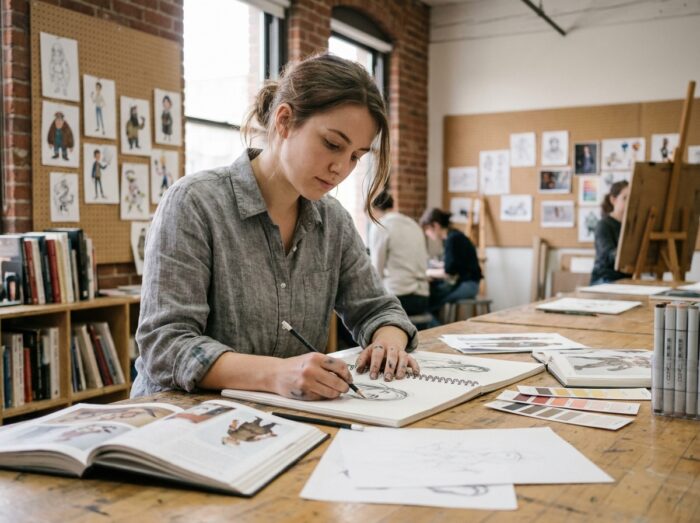
A future concept artist looking for training does not only consider the drawing program. They evaluate a school’s ability to prepare them for a specific market, whether it be video games, animation, or visual effects. Some illustration schools capture this attention much better than others, and the reasons go far beyond the quality of perspective courses.
Market contraction in concept art and pressure on school choice
The video game sector in France generates over 7 billion euros in revenue and employs more than 10,000 professionals. These figures give the impression of an open market. The recent reality is different.
According to data from AFJV, the number of job offers in video games has decreased by 71% between 2022 and 2025. This drop profoundly changes the logic behind choosing a school. When positions become scarce, training becomes a filter: studio recruiters first look at where the candidate comes from, what kind of portfolio guidance they received, and whether they had real contact with production.
Schools that respond to this pressure share three characteristics. They have a targeted focus on concept art (not just an option among twenty specialties). They offer intensive, often individualized portfolio support. And they maintain a direct connection with studios through professional interventions or integrated internships in the curriculum. Among the illustration schools that attract future concept artists, this triptych consistently appears.
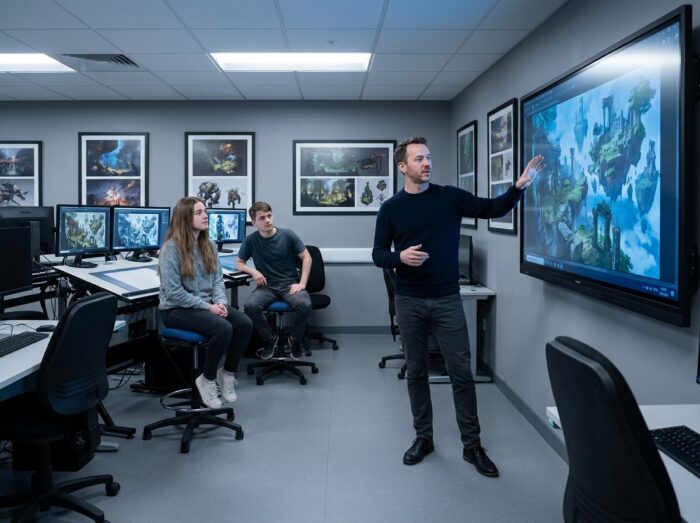
Portfolio and guidance: what distinguishes a concept art-oriented illustration school
Why does the portfolio matter so much? Because a concept artist does not sell a diploma; they sell a portfolio. An art director in a studio spends just a few seconds on each application. What they are looking for is visual coherence, the ability to tell a universe, and technical mastery on assigned subjects (creature, environment, accessory).
A generalist school in applied arts teaches drawing, color, and composition. These foundations are necessary. However, it often leaves the student to build their portfolio alone, without precise guidance.
Specialized schools guide the construction of the portfolio as a professional project. The student receives briefs modeled on real commissions. They produce research boards (character design, environment design) that follow studio codes. Active professionals review and correct the work, sometimes every week.
The role of the imposed brief in progression
Working on a free subject allows for style development. Working on an imposed brief forces one to solve a visual problem under constraints, which corresponds to the daily life of a concept artist in a studio. Schools that alternate between the two approaches produce more convincing portfolios for hiring.
- The free brief develops the student’s graphic identity and personal universe, which recruiters sometimes refer to as the “visual voice.”
- The imposed brief tests the ability to respond to a precise artistic direction, with constraints on style, palette, or theme.
- The regular alternation between the two teaches how to switch from one register to another, a sought-after skill in studios that change projects every two or three years.
Integration of generative AI into illustration curricula
Another, more recent factor of attractiveness concerns the role of artificial intelligence in training. The subject divides the profession: some graphic designers and illustrators openly criticize AI-generated visuals, particularly posters produced without human intervention.
Some schools have chosen to integrate AI as a working tool rather than ignore it. Programs now include AI image generation and augmented retouching in their curriculum. The goal is not to replace drawing but to learn to use AI as a quick research step before final production.
For a future concept artist, knowing how to generate variations in ambiance in just a few minutes and then refine them by hand represents a concrete time-saving in the pre-production phase. Schools that teach this process meet a demand from studios that are beginning to integrate these tools into their pipelines.
Why this skill changes the hiring game
A candidate who masters both traditional drawing and AI tools positions themselves in a still underpopulated niche. Recruiters see this as an adaptable profile, capable of evolving with production methods. Schools that offer this training thus attract students concerned about their medium-term employability.
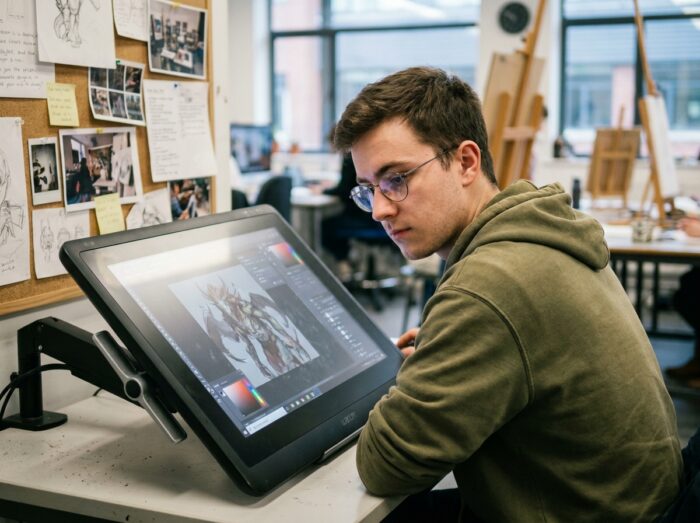
Professional network and access to studios: a often decisive criterion
The last lever of attractiveness may be the least visible from the outside. Access to a school’s professional network weighs as much as the quality of education in a student’s decision.
A former student working in a studio can recommend an intern. A professional guest can spot talent during a workshop. These informal connections are not listed in any brochure, but they often determine the acquisition of a first contract.
- Schools located in cities where studios (animation, video games, visual effects) are concentrated facilitate short internships and informal meetings.
- End-of-year juries open to external art directors create direct recruitment opportunities.
- Active alumni communities on professional platforms serve as information relays for open positions.
Have you noticed that some schools regularly place their graduates in the same studios? It’s not a coincidence. It’s the result of network-building work done over several graduating classes.
The choice of an illustration school to become a concept artist is therefore based on very concrete criteria: quality of portfolio guidance, presence of AI in the curriculum, and density of the professional network. In a market where offers are contracting, these three elements make the difference between a training program that opens doors and one that leaves the student to knock alone.