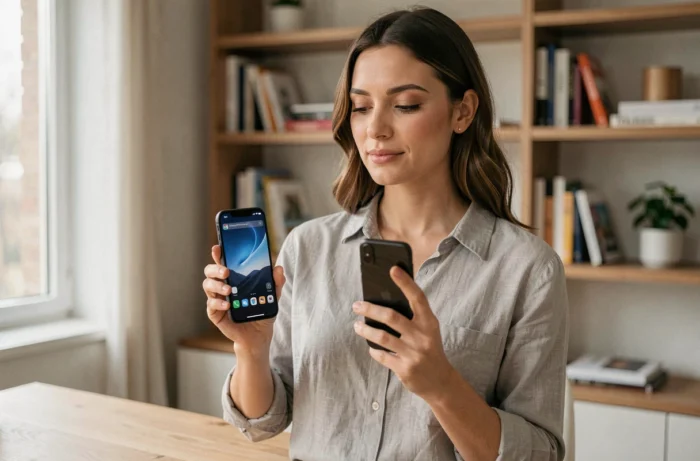
The iPhone 7 and iPhone 7 Plus share the same processor generation, operating system and much of their technical specifications. The differences between them come down to three key factors: screen size, camera system and battery life. Understanding these differences can help you decide which one best suits your everyday needs.
iPhone 7 Plus dual camera: what optical zoom brings to the table
The camera system is the most notable difference between the two models. The iPhone 7 has a single sensor, while the iPhone 7 Plus features a dual camera combining a wide-angle lens and a telephoto lens. This setup enables 2x optical zoom on the 7 Plus, whereas the iPhone 7 is limited to digital zoom, which reduces image sharpness.
Both models feature optical image stabilisation and an f/1.8 aperture, improving low-light photos compared with previous generations. The difference is most noticeable in Portrait mode: the 7 Plus’s dual camera creates a depth-of-field effect (blurred background) that the iPhone 7 cannot reproduce.
If you mainly use your camera in straightforward conditions (daylight, no zoom), the iPhone 7 is still a good fit. However, when it comes to choosing between the iPhone 7 and 7 Plus for photography, the Plus’s dual camera offers genuine versatility, particularly for portraits and distant subjects.
Screen size and battery life: two factors linked to the phone’s dimensions
The iPhone 7 has a 4.7-inch screen, while the 7 Plus has a 5.5-inch screen. Both displays use IPS LCD Retina technology and offer similar colour reproduction, but their resolutions differ. The 7 Plus has a higher resolution thanks to its larger display.
This difference in size directly affects ease of use. A 5.5-inch screen gives you more room for reading, watching videos and browsing the web. On the other hand, the 7 Plus is difficult to use with one hand and is noticeably heavier.
Battery: the Plus’s built-in advantage
The 7 Plus’s larger chassis accommodates a higher-capacity battery. In everyday use, this translates into several extra hours of battery life compared with the iPhone 7. For intensive use (streaming, GPS, photography), the difference becomes significant over the course of a full day.
The A10 Fusion processor is identical in both devices. Raw performance (app launch speed, interface responsiveness) is the same on both models. Battery life is the only technical advantage tied to the larger form factor, apart from the screen size itself.
Network compatibility and the 3G shutdown: something to check before buying
Standard comparisons focus on the screen and camera, but a less obvious factor is also worth considering. The gradual shutdown of 2G and 3G networks in France directly affects older iPhone models. For both the iPhone 7 and 7 Plus, VoLTE support determines whether the phone can make calls over 4G.
If your carrier’s 3G network has been switched off and VoLTE is not enabled on the device, voice calls may fail even if 4G internet browsing still works. Before buying either model, check that VoLTE is compatible with your carrier and SIM card to avoid an unpleasant surprise.
End of iOS support: a shared limitation
Neither iPhone can run recent versions of iOS. Some third-party apps are starting to require newer iOS versions, gradually reducing the range of available apps.
This software limitation applies equally to both models. Choosing between the iPhone 7 and 7 Plus makes no difference to how long they receive software support: it is the same for both.

Buying a refurbished iPhone 7 or 7 Plus: what to check
Today, these two models are mainly available on the refurbished market. Beyond the technical differences between the two versions, the actual condition of the device you buy matters just as much as your choice of model. Three things deserve particular attention:
- Battery condition, which you can check in iOS settings: a degraded battery will significantly reduce battery life, especially on the iPhone 7, whose battery is smaller to begin with
- The seller’s warranty and battery replacement terms: some refurbishers include a replacement, while others do not
- Actual VoLTE compatibility with your carrier, which you should test as soon as the phone arrives rather than assume based on the specifications
Battery condition matters more than which model you choose for everyday use.
The choice comes down to a simple trade-off. The iPhone 7 Plus offers a better camera (dual sensors, optical zoom and Portrait mode), a larger screen and longer battery life. The iPhone 7 has a compact, lighter and easier-to-handle design. In terms of performance, software and network compatibility, the two devices are identical. The deciding factor is what matters most to you: photography and a larger display, or portability.