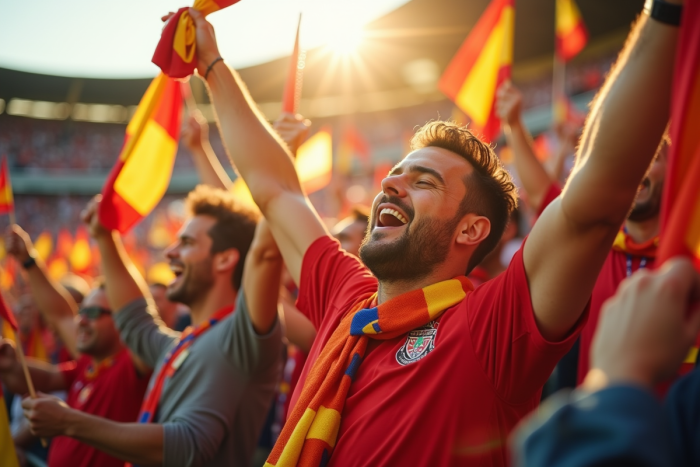
The kid doesn’t look at the score; he scrutinizes the faces of the elders, their tense smiles, the hand gripping the pennant. It’s not just a match being played on this battered pitch: it’s a whole chapter of history being written with every pass, the memory of a neighborhood, an identity that is caught like an accent and defended like a family secret.
In the stands, the intertwined generations are countless, the voices harmonizing more or less accurately but always with conviction. How can a simple club, lost among others, become the compass of a region, transform eleven players into totems, and infuse every victory with a scent of eternity? Here, the attachment clings much stronger than any scoreboard.
When a club’s history shapes a region’s identity
In the patchwork of French football, each club weaves its own legend. Far from the limelight of Ligue 1, it is often in tiny stadiums that epic tales are born, where fervor spills over the stands and seeps into daily life. From Départemental 1 to the national peaks, a club’s progress becomes the red thread of a city, the backbone of a village. The structure of the leagues – from Régional 3 to National, then to Ligue 2 and Ligue 1 – imposes an unyielding hierarchy, the result of decades of contests and reforms that have made more than one pitch vibrate.
A club is above all a story of passing the baton. Training centers bring forth talents, sometimes anonymous, sometimes Sunday heroes, sometimes future pillars of the first team. Jerseys change hands, but the passion does not fade. In Auxerre, the epic of AJA 1905 embodies all the power of regional roots: a club that becomes a landmark, a source of pride, a driving force for an entire territory.
The trajectory of a team is not only written with trophies. It is inscribed in the yellowed notebooks of municipal archives, in the intensity of derbies, in the ability to be reborn after storms, whether economic or historical. Look at amateur clubs: they make football a tool for integration, a social glue, a beacon for the community. Every promotion, every relegation, every pivotal match reinforces a sense of belonging, expanding the local legend.
- Ligue 1 consists of 18 teams and represents the pinnacle of French professional football.
- Ligue 2 and National mark the ascent and relegation, energizing the regions.
- Amateur clubs form the foundation of talent and the core of loyal supporters.
The power of a club is this miracle: to succeed, year after year, in embodying a region, raising its colors on the national stage, and rooting itself in collective memory like a familiar legend.
Shared passion: how does a club become the beating heart of an entire territory?
In every town, every neighborhood, the local club far exceeds the simple playing field. The attachment seeps through the stands, circulates around the counters, spreads on social media. Supporters are the pillars: they are there, whether it’s Ligue 1, Ligue 2, National, or regional divisions. Their loyalty doesn’t care about rankings or schedules. Some travel across France to follow a National away game, while others plant their flag on the handrail of a Départemental 1 pitch. Seasons pass, but the fervor remains.
The Coupe de France embodies this great gathering. More than a competition, an institution: it brings together amateurs and professionals, offering each club a chance to invent its destiny, to hope for an upset or a final at the Stade de France. There, the supporters’ chants transform the arena into a popular theater. The Trophée des Champions opens each season by pitting the Ligue 1 winner against the Coupe de France champion – a rite of passage for the ambitious.
But a club is also a business: broadcasting rights, sponsors, ticket sales keep the machine running. Ligue 1 stadiums compete in modernity, but the attachment is never limited to performance or architecture. It is nourished by shared stories, transmitted memories, a pride that ignites every weekend.
- Sponsors fuel the growth of professional and semi-professional clubs.
- Ticket sales and TV rights ensure the financial stability of elite clubs.
Football is not just a sport: it is the fuel of an entire territory, a social dynamic, a part of the heritage that is invented and passed down, generation after generation. That’s why sometimes, a simple jersey makes an entire country beat.