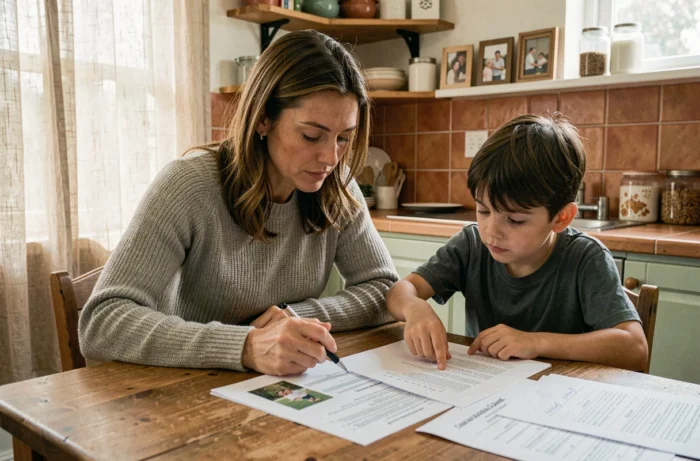
The expectations expressed by parents revolve around four main areas: finding concrete solutions to the difficulties encountered, sharing their experiences with other parents, obtaining general information about their role, and acquiring skills. The landscape of available resources has significantly changed since the beginning of 2025, with a transfer of skills to municipalities and the emergence of mobile or remote services.
Welcoming young children: what decentralization to municipalities changes
Since January 1, 2025, the law for full employment has entrusted municipalities with specific missions regarding the care of young children. They must now assess local needs, inform parents about the available offerings, and plan childcare places in their territory.
This transfer modifies the practical entry point for families. Municipalities, CCAS, and early childhood networks become key contacts, in addition to the CAF and PMI. For a parent looking for a daycare spot or information about childcare options, the municipality is no longer just an administrative relay: it bears direct responsibility for organizing the offerings.
Families consulting the Devenir Parent website for families find additional references regarding parenting-related procedures, especially when local contacts do not cover all questions.
The limitation of this system lies in the heterogeneity of municipal resources. A rural municipality with a few hundred inhabitants does not have the same engineering capabilities as a metropolis. Feedback from the field varies on this point: some small municipalities have quickly structured their offerings through intercommunalities, while others struggle to identify a dedicated contact person.
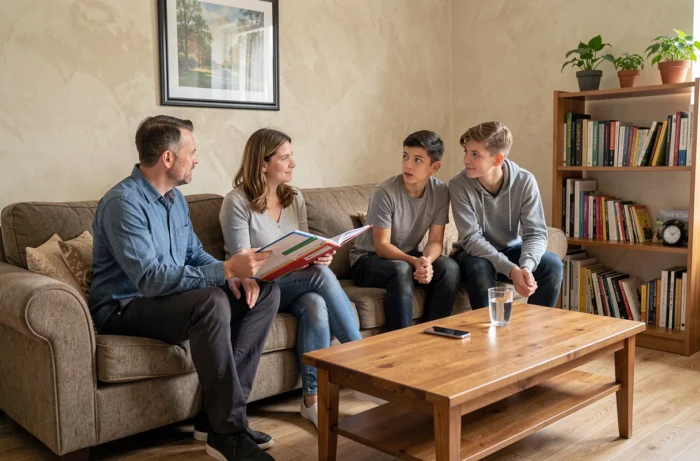
Mobile services and remote support: reducing access inequalities
One of the blind spots in family policies remains geographical access. Concentrating resources in urban centers leaves aside families in remote areas, who are sometimes the ones in greatest need.
So-called “outreach” services attempt to bridge this gap. The Family Bus, tested in Eure-et-Loir, combines access to rights, parenting support, and a mental health component in one vehicle. This type of mobile service allows reaching audiences who would not step through the door of a fixed structure, whether due to lack of knowledge, distance, or institutional distrust.
Free telephone support: the example of Lozère
A confidential and free listening service has been established by the CAF of Lozère under the name “Côté parents 48.” It allows parents to obtain answers about family life and guidance towards an appropriate structure. This service does not replace psychological or therapeutic follow-up, but it serves as a first point of contact for isolated or questioning parents.
This model of remote support functions as a complement to physical locations. It addresses a simple constraint: in a rural department with low density, offering only in-person appointments mechanically excludes some families.
Perinatal mental health and parenting support: a recent convergence
Perinatal mental health is now integrated into parenting support policies. This convergence was not a given. For a long time, perinatal follow-up was limited to the medical dimension (pregnancy monitoring, childbirth, post-natal follow-up), while parenting support belonged to another sphere, often associative.
The convergence of these two fields responds to a clinical observation: mental health difficulties occurring around birth (postpartum depression, parental anxiety, attachment disorders) have a direct impact on parents’ ability to fulfill their role. Addressing these issues separately meant leaving a blind spot in the proposed support.
The available data do not yet allow measuring the concrete effect of this integration on the ground. Initial feedback suggests that the early detection of parental vulnerabilities improves when perinatal professionals and those providing parenting support share a common framework.

Disability and parenting: towards better coordination of pathways
Families of children with disabilities face specific constraints: multiple contacts (MDPH, medical-social establishments, National Education, freelance professionals), administrative complexity, and frequent isolation. Support is oriented towards better coordination among these actors to prevent parents from having to coordinate their child’s journey alone.
Three areas of work emerge from recent developments:
- Breaking down barriers between medical-social structures and parenting support services, so that parents of children with disabilities can access the same resources as other families without a parallel pathway
- Developing specific support groups, where parents share their experiences with others facing similar situations, responding to the demand for peer exchange identified by the CAF
- Adapting information materials to disability situations, including for parents themselves who are disabled and become parents
The reported sense of difficulty among these families remains higher than average. The challenge is not just to add new services but to simplify access to existing resources that often remain unknown or fragmented.
What parents really expect from parenting actions
Surveys conducted among families outline a clear profile of expectations. Requests focus on solving concrete problems, sharing experiences, and accessing information. The acquisition of parenting skills comes last.
This hierarchy suggests that parents are primarily seeking operational answers, not theoretical content. A workshop on managing sibling conflicts, rooted in lived situations, better meets this demand than a general conference on child development.
The age groups perceived as the most challenging by parents are adolescence and pre-adolescence. The support offered for parenting, historically concentrated on early childhood, would benefit from better covering the support for parents of teenagers, where the sense of difficulty is most pronounced.