What criteria allow us to distinguish a fleeting seasonal trend from a fundamental movement that redefines shopping habits? This season’s fashion and lifestyle trends are reflected as much in color palettes and cuts as in the regulatory requirements that now govern the manufacturing and sale of clothing in Europe.
Digital passport and textile traceability: what changes for style this season
Competitors list items to buy. None mention the European regulatory framework that will change how these items arrive in stores. The ESPR 2025-2030 work plan, adopted in 2025 by the European Commission, provides for the gradual implementation of a digital passport for textile products. This system will link each item to verifiable data: composition, origin, chemical compliance, reparability, end of life.
In practical terms, a QR code, NFC chip, or RFID tag integrated into the garment will provide access to this information. The obligation does not yet generally apply to clothing, but brands selling in the European market, including those whose manufacturing takes place outside the Union, will need to prepare for it.
For consumers, adopting the season’s trends also means checking the actual durability of an item before purchasing it. Choosing a leather coat or a dress made from blended fibers without knowing their traceability will become increasingly incompatible with market standards. Specialized publications like carnet-de-tendances.fr are already documenting this convergence between style and transparency.
Autumn-winter color and material trends: comparative table
Rather than listing isolated pieces, cross-referencing color, material, and sustainability constraints allows us to identify the combinations that dominate this season.
| Trend | Dominant Color | Key Material | Sustainability Advantage |
|---|---|---|---|
| Leopard print | Fawn, brown, black | Certified viscose, recycled polyester | Facilitated reuse (timeless pattern) |
| Leather and faux leather | Black, burgundy, cognac | Vegetable-tanned leather, bio-sourced faux leather | Documented reparability |
| Terracotta-rust palette | Ochre, rust, terracotta | Mixed wool, thick cotton | Low-impact dyes |
| Metallic touches | Silver, pale gold | Metallic threads on a textile base | More complex recycling (mixed fibers) |
Leopard print returns every autumn, but its longevity in wardrobes makes it a reuse ally. In contrast, metallic touches pose a recycling problem: metal-textile mixed fibers complicate sorting at end of life.
Genuine leather or bio-sourced alternatives
Leather remains a strong marker of autumn-winter style. The difference this season lies in the growing offer of bio-sourced faux leather made from plant residues. These alternatives do not yet compete with full-grain leather in longevity, but their carbon footprint during production is lower.
The choice between leather and faux leather depends on the intended use and frequency of wear. A jacket worn daily justifies an investment in durable leather. A skirt worn every other season can turn to bio-sourced without losing style.
Destruction of unsold textiles: the direct impact on seasonal collections
The destruction of unsold textiles is now prohibited for large European companies. Medium-sized enterprises will be affected starting July 19, 2030. This regulation promotes models of stock clearance, reuse, donation, and resale.
The effect on fashion trends can be measured at several levels:
- Brands produce tighter collections, with fewer references per season, reducing the risk of unsold items and concentrating style on versatile pieces.
- The second-hand market absorbs surpluses, making pieces from previous seasons accessible at reduced prices, including leopard prints or leather jackets.
- Consumers access quality pieces through stock clearance rather than fast fashion, changing the perception of the “good price” for a trendy garment.
Adopting the season’s trends no longer solely involves buying new. Reuse is becoming a legitimate acquisition channel, even for current pieces.
Autumn-winter look: combinations that last several seasons
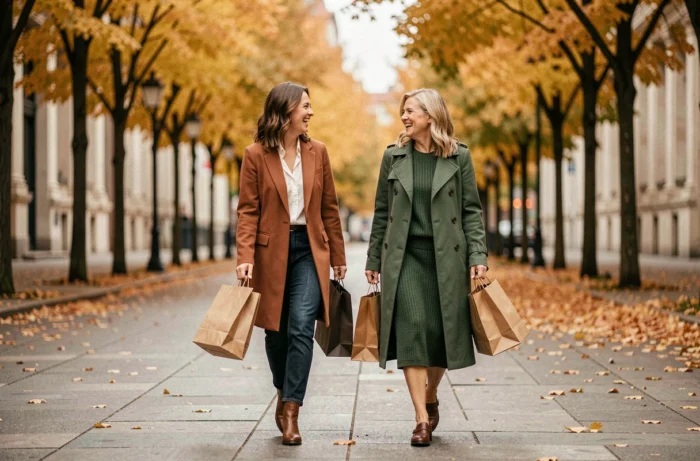
Focusing on combinations of pieces rather than isolated items increases the longevity of a look. A thick cotton trench paired with wide wool trousers withstands trend changes because each piece also works separately.
Three combinations with strong stylistic longevity
- Solid midi dress (terracotta or black) worn with leather ankle boots and a defined belt: this trio carries through autumn and winter without adjustment.
- High-waisted straight jeans, thick knit sweater, and oversized blazer: a structured look that absorbs trend variations without appearing dated.
- Knee-length pleated skirt, fine turtleneck, and faux leather jacket: the contrast of materials creates a bold style that does not rely on a seasonal print.
The common thread of these combinations is the absence of any piece too marked by a micro-trend. Leopard print can be integrated as an accessory (scarf, bag, belt) without becoming the central axis of the look.
Neutral colors versus bold colors
Neutral palettes (beige, gray, black, off-white) remain dominant in sustainable wardrobes. Bright colors work better as accents than as a total look to maintain flexibility of combinations over several seasons. A rust scarf or a burgundy bag is enough to anchor a neutral wardrobe in autumn-winter codes.
The season boils down to a trade-off between immediate visibility and longevity. European regulatory data pushes the market towards traceable and reusable clothing, aligning legal constraints for the first time with a stylistic approach based on the durability of pieces rather than their rapid replacement.